CANCELED - Learning to draw in India
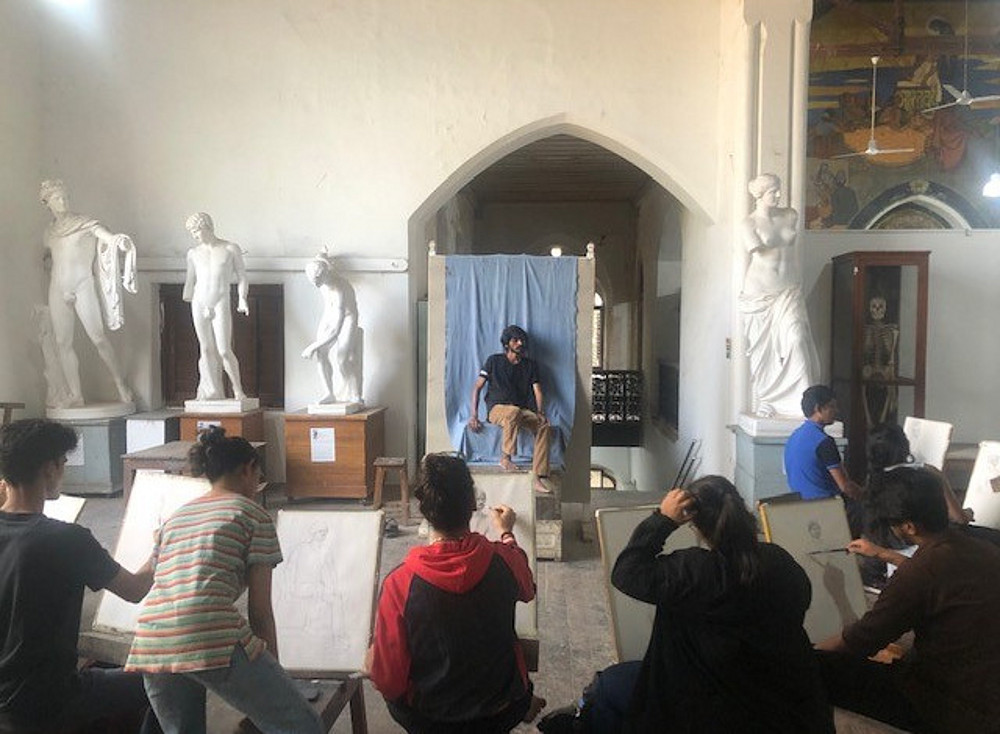
Photo of a drawing course at the J.J. School of Art, Mumbai
Due to strikes by Deutsche Bahn and Lufthansa, the guest lecture has to be canceled and will be postponed to another date!
The Department of Art and Musicology is delighted to invite you to the lecture "Learning to Draw in India. Colonial and national claims to a controversial skill" by Prof. Eva Ehninger (Department for Art and Visual History, Humboldt University of Berlin).
During the second half of the 19th century, the British colonial government established four schools of arts and crafts in the cities of Madras, Calcutta, Bombay and Lahore. By centralizing and formalizing the training of craftsmen, the quality of Indian arts and crafts was to be permanently secured for global trade. The curriculum of the schools was strictly based on the model of the National Art Training School, located in the South Kensington Museum, London, where drawing was regarded as the decisive basis for both craft and artistic training. After the transformation of India and Pakistan into two independent nation states, these originally colonial institutions began their second career as national art academies in the mid-20th century. My lecture addresses the role of drawing in this institutional context. The focus on the changing evaluation and mediation of this artistic skill enables me to discuss the relationship between the decorative arts and art, or the production of colonial trade goods, and the construction of national cultural identity in a new way.
Eva Ehninger is Professor of Modern Art History at the Institute of Art and Visual History, Humboldt University of Berlin. Since January 2024, she has co-directed the newly founded Käte Hamburger Center for Advanced Study in the Humanities inherit. heritage in transformation with Sharon Macdonald. She is interested in how cultural heritage is transferred to other media and integrated into different historical and cultural contexts, and how these dynamics change the meaning and valuation of cultural artifacts. Current research interests include exploring different conceptions of education and alternative notions of time and history in colonial, postcolonial, transnational and transcultural contexts, with a geographical focus on India.