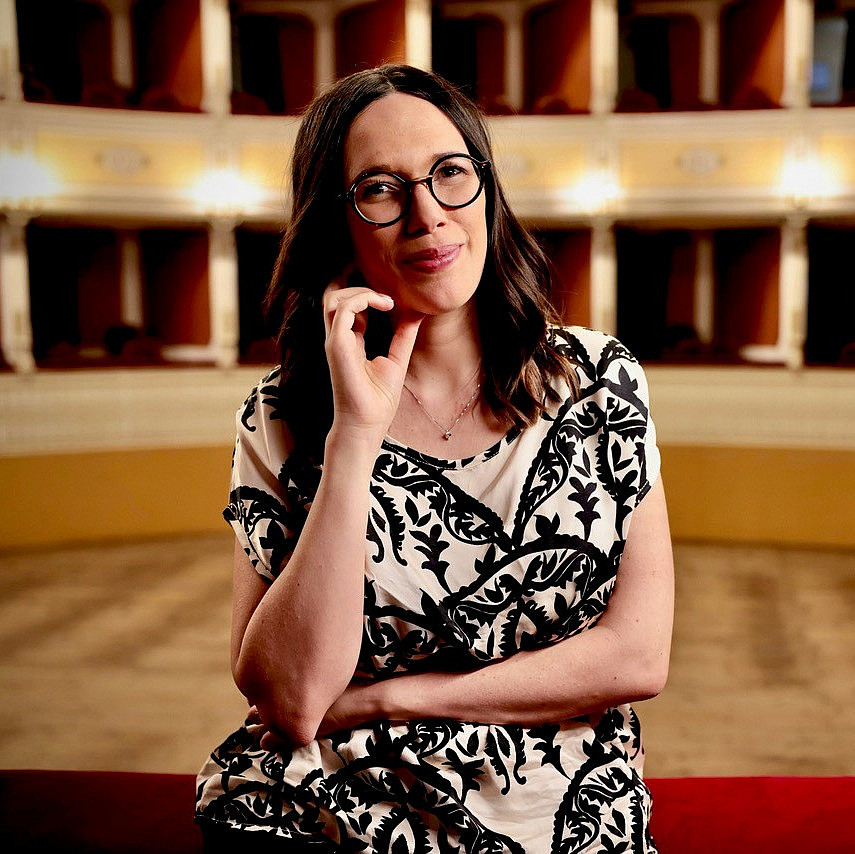
Elena Minetti
The research interests of musicologist Elena Minetti lie at the interface between musical notation, sketches and compositional processes on music from the 19th to 21st centuries, with a particular focus on aesthetics, media studies and digital aspects.
Her current research project – which she began as a fellow of the German Historical Institute in Rome, then continued as part of the program “PILOT” at the University of Kassel and now as a university assistant at the University of Graz – is dedicated to the analysis of posthumous finalisation of operatic fragments. On the basis of selected case studies, the project will investigate the following questions: who, for what reasons, with what intentions, in what context, with what compositional techniques and aesthetics and at what point in time, took up and completed an unfinished work. Her research aims to build a bridge between the original creation of compositions and their later reception, reconstruction and further composition. The theoretical examination of completion practices requires theoretical approaches from musical reception and interpretation research, as well as methods from music philology, creativity research and the digital humanities (particularly with regard to the use of artificial intelligence in art and music). With interdisciplinary consideration of similar practices from the fields of art, literature and theatre studies, her project contributes to a theoretical understanding of the artistic creative genesis, and also to the rethinking of fundamental concepts such as authorship, authenticity, originality as well as work, fragment and conclusion. Moreover, she will investigate the exploration of “extended collaboration”, which did not come about through personal encounters, but rather on the basis of confrontation with musical, literary and self-testimonial materials.
Compositional processes – albeit regarding electroacoustic music – were also at the centre of Elena Minetti's dissertation Schrift als Werkzeug: Schriftbildliche Operativität in Kompositionsprozessen früher musique mixte (1949-1959) [Writing as a Tool: Written Operativity in Compositional Processes of Early Mixed Music (1949-1959)]. As part of the D-A-CH research project Writing Music. Iconic, Performative, Operative and Material Aspects in Musical Notation(s), her work focussed on writing in the compositional processes of early mixed music. By examining musical notations at a moment in music history when the recording of electroacoustic sounds became an integral part of compositions, her dissertation aimed to shed new light on a subject that had previously only been sporadically researched, while at the same time providing insights into the history of the creation and reception of works by Daphne Oram, Bruno Maderna, Mauricio Kagel and Luciano Berio.
Through her work as a research assistant on the DFG project Henze Digital at the University of Paderborn, she developed a strong interest in the possibilities that the digital humanities offers for musicological research. In this project, according to the guidelines of the Text Encoding Initiative (TEI) and its correspondence-specific mark-up forms, she edited correspondence between Hans Werner Henze and selected correspondents from his artistic network.The musicological comments and the encoding of entities (e.g. persons, places, organisations, etc.) have ensured that the letter edition Henze Digital is as open and accessible as possible.