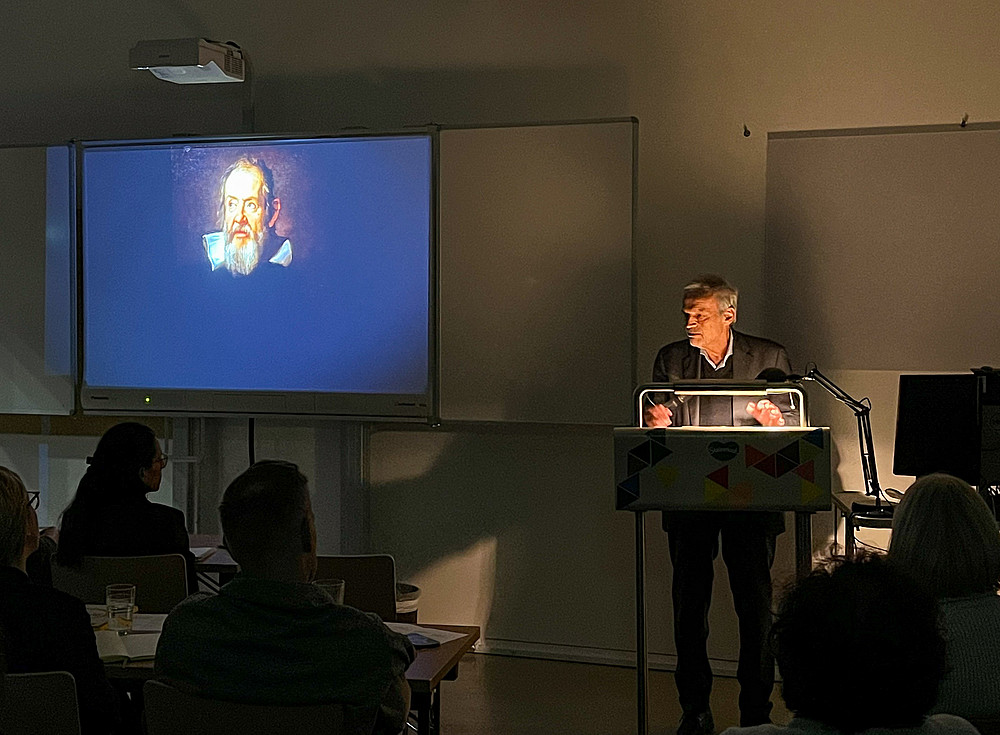
After an introductory welcome by the organisers Julian Blunk and Robert Felfe (Graz), the conference, co-organised by student assistants Elisabeth Jehn and Simone Walzl, opened with a lecture by Bert van de Roemer (Amsterdam) on the topic of Cross references between the Book of Arts and the Book of Nature. This was followed by contributions on the historical constitution of concepts of nature and art in the lecture by Simone de Angelis (Graz) and on the negotiation processes between model and ideal in Clara Lespessailles (Paris). Julian Blunk (Graz) then focussed on the stylistic appropriation of the demiurge in the 19th century, before Lee Chichester (Bochum) shed light on creative epistemes in Dárcy W. Thompson's organic theory of form. Horst Bredekamp (Berlin) concluded the first day with an impressive evening lecture on style as a form of cognition, in which he vividly combined historical references and current debates in art history. This was followed by a reception in the Modern Greenhouse of the Botanical Garden, where participants were invited to exchange ideas and engage in dialogue.
On the second day, Robert Felfe (Graz) focussed on art-historical theories of stylistic development around 1900, before Chonja Lee (Neuchâtel) provided an overview of plant and artificial intelligence in contemporary art. Sabine Flach (Graz) focussed on the border areas between the living and the artificial, followed by biologist Thomas Schmickl (Graz), who was the only participant from a scientific-technical discipline to take a look at emergent life-like structures in systems. The final contribution was by Saskia Jaszoltowski (Graz), in which she analysed the role of non-human life in Björk's artistic practice and self-portrayal.
The conference offered a lively and inspiring exchange between international scientists as well as Graz researchers and students from various disciplines.