Global extractions – Transcultural relations?
Critical and artistic perspectives in the face of exhausted worlds
Heinrich-Heine-Universität, Düsseldorf
Nov 4, 2025 - Febr 5, 2026
Organisation:
Dr. phil. Franziska Koch, Transkulturelle Studien I, Institut für Kulturwissenschaten, Heinrich-Heine-Universität Düsseldorf and the Working Group Art Production and Art Theorie in the Age of Global Migration (Ulmer Verein. Verband f. Kunst- u. Kulturwissenschaten e.V.)
Online and hybride Lectures (German) at the HHU in room 2302.02.45
Meeting-Link:
https://hhu.webex.com/meet/fkoch
Meeting-No: 2731 620 5149, Video-Adresse fkoch(at)hhu.webex.com, Audio connection:
Germany Toll +49-619-6781-9736, access code: 2731 620 5149
Di. 3. Februar 2026, 16:30-18:00 (online)
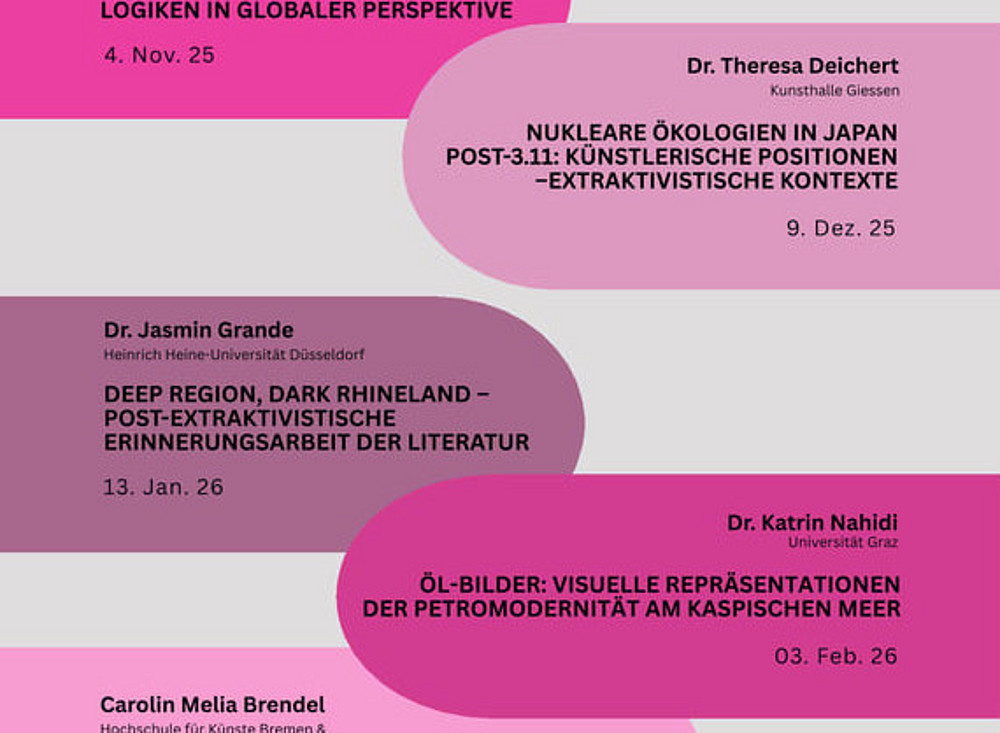
Katrin Nahidi
Oil paintings: visual representations of petro-modernity on the Caspian Sea
In this lecture, the concept of "petromodernity" is developed as an analytical lens to reveal the interconnections between fossil energy and coloniality. Based on postcolonial theory and decolonial thinking, it is argued that petromodernity can serve as a case study to demonstrate the coloniality of modernity. Petroleum functions as a material regime and epistemic matrix that shapes the economy, infrastructures and modern subjectivities as well as geopolitical orders and art-historical narratives. In short, one could say that there is no modernity without petroleum.
Nevertheless, the material realities of oil and gas production often remain systematically invisible behind aestheticised images. This is a symptom of extractivist practices that obscure resources, labour, knowledge and data and produce depoliticising effects in the sense of Timothy Mitchell's "Carbon Democracy". Using the example of the Caspian Sea as an early hub of petro-modern developments, the exhibition traces how oil flows shaped European markets, stabilised colonial and capitalist power structures, and contributed to the selectivity of the art-historical canon. Artistic case studies on contemporary counter-narratives from the region reveal the socio-ecological consequences, make the logic of selective visibility of infrastructure tangible, and shift viewing habits and narrative forms.