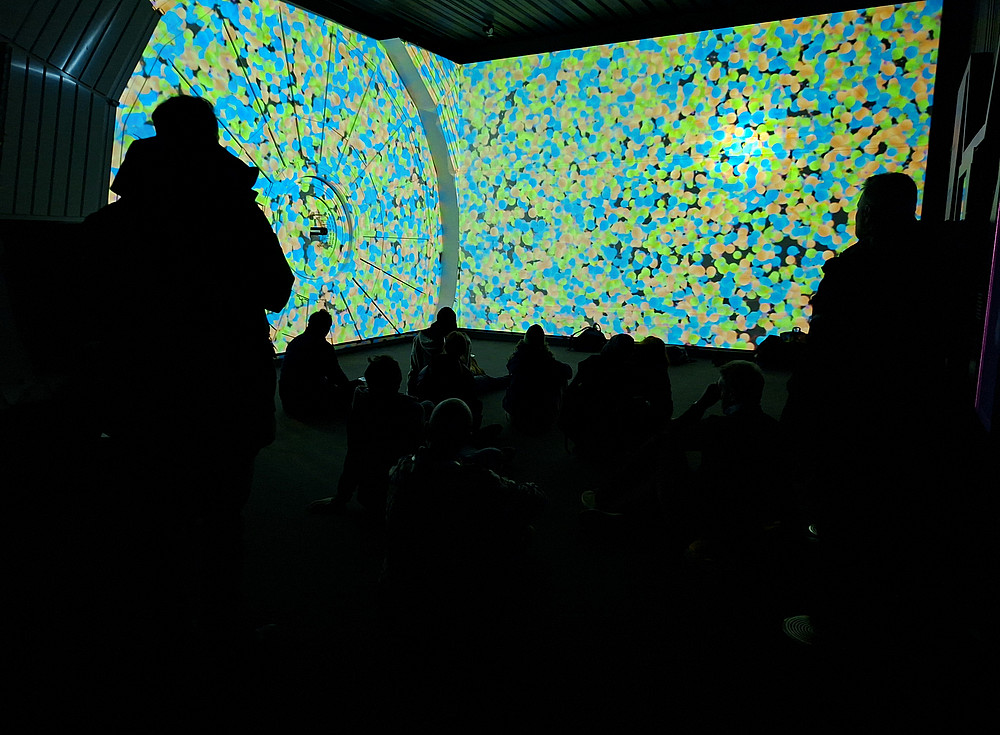
Physics and art in dialogue: As part of the activities of the humanities focus area Perception: Episteme, Aesthetics, Politics, a group of researchers and students from Graz with diverse academic backgrounds visited the world-famous CERN research centre in Geneva. The experts from philosophy (Dr Philipp Berghofer and Lioba Strieder), physics (Georg Wieland and Niklas Notter), religious studies (Prof. Franz Winter), musicology (Prof. Susanne Kogler and Joep Janssens) and art history (Raphaela Miklauc) as well as co-curator of the ORF musikprotokoll Susanna Niedermayr were warmly welcomed at CERN by Dr Michael Hoch, who works there. As part of a multidisciplinary collaboration between various arts, humanities and natural sciences, students and scientific and artistic experts from all over the world came together to enter into a dialogue about the importance and potential of combining the natural sciences, humanities and arts.
UXC55 X4 balcony/ CMS open - 5th May 2023
In addition to stimulating lectures from the fields of physics, religious studies, musicology and art history, science education and pedagogy, artists presented their works. The open-minded atmosphere of the event facilitated fruitful discussions that invited artists, humanities scholars and scientists to understand phenomena beyond the horizons of their own disciplines. Other highlights of the workshop week were the excursions to the various research sites at CERN, including three particle accelerators. On Monday 12 January, the group visited the ALICE experiment, where quark-gluon plasma is produced and measured, a material that can tell us something about the state of our universe directly after the Big Bang. The guests then visited the CERN Control Centre, where the 27 km long particle accelerator is continuously monitored. The next stop was the CMS experiment. Here, the existence of the Higgs boson, which was theorised in 1964, was empirically confirmed in 2013. On the same day, the interdisciplinary society also visited the control chamber of the AMS-02, where a cosmic ray detector on the International Space Station (ISS) is being used in an attempt to better understand antimatter and dark matter. The next day, the group travelled to the Antimatter Factory, where they were informed about the ELENA decelerator ring, which is used to produce and study antimatter. The CLOUD experiment was visited the next day. This deals with research into aerosols and clouds - important phenomena with regard to the Earth's climate.
To the programme (with detailed photo documentation of the SciArt Dialogue Week Conference 2026)
Participating (art) institutions: University of Graz, Kunstuniversität Graz, ORF musikprotokoll im steirischen herbst, Art Department & Communication Department FSU Florida State, University, University of Alabama Art & Art History Department and Journalism, Creative Media Department, Pädagogische Hochschule Wien, RMIT Melbourne, Australia, and ORF Ö1 Austria.
The finished artworks will be presented as part of the ORF festival musikprotokoll im steirischen herbst 2026 (8-11 October 2026).