


Joep Janssens, whose research focuses intensively on the interplay between nature, politics and identity in the 19th century, spoke in Ljubljana on ‘Losing one’s self in the national collective. Student drinking songs and the construction of a German identity in the 1820s and 1830s”.
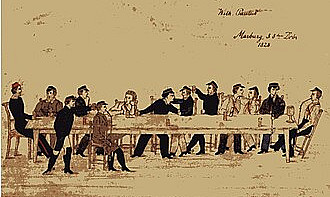
In his lecture, he examined, through an analysis of the drinking songs in Albert Methfessel’s (ed.) significant student song collection *Allgemeines Commers- und Liederbuch* from the 1820s and 1830s, he demonstrated that these songs possessed strong identity-forming potential in the context of emerging nationalism. Singing and drinking together were part of everyday life in the student fraternities and provided opportunities to express ideals of national unity and to strengthen a sense of belonging.
Around half of the song collection consists of drinking songs, whose lyrics often celebrate a hedonistic lifestyle and are characterised by humour. It was precisely the combination of political message and seemingly carefree cheerfulness that was able to have a particular impact under the restrictive political conditions of the time: humour alluded to political convictions without immediately revealing their seriousness. Simple, folk-song-like melodies and playful call-and-response structures conveyed notions of a shared ‘people’.
More than half of the drinking songs examined contain explicitly political themes. These include overcoming class divisions, loyalty to Germany, national liberation and warfare, as well as distinguishing Germany from France. Toasts to the German nation and its heroes linked these themes to communal drinking rituals, which simultaneously reaffirmed the hierarchies of the student fraternities and staged the fulfilment of individual duties for the benefit of the community.
Rhine wine plays a special role. The Rhine region had increasingly become a symbol of German freedom in the face of France. In the songs, this politically charged landscape was not only celebrated in verse but also made tangibly experiential through the shared enjoyment of wine. As the students were regarded as the future generation of leading intellectuals, the study suggests that the drinking songs contributed to the long-term process of German nation-building beyond the immediate communal occasion.
As early as mid-September, Joep Janssens was invited to a conference in Pula entitled ‘Soundscapes of Entertainment: Music at Leisure in the 19th Century’ (programme). Here, too, he examined the role of communal singing during multi-day hikes (gymnastics excursions) organised by the emerging German gymnastics movement in the late 1810s “Hiking – Singing – Soundscapes. Collective Singing, Landscape and National Identity in the Turnfahrten of the Early German Gymnastics Movement.”
Music can have a stronger formative impact on collective identities when it is combined with active bodily participation in the rural outdoors, thereby amplifying the political significance of music at leisure. Although music about the landscape has been widely researched, the meaning of music performed within the nineteenth-century landscape still is relatively underexplored. Important activities of the gymnasts were the Turnfahrten, multi-day group hikes in order to learn the histories and nature of the fatherland by embodied means. Almost all these hike’s activities were characterised by collective singing, in which they expressed their national ideals. The repertoire consisted of patriotic, religious, and martial songs and contrafacta, particularly those of the then still recent 'Wars of Liberation'. The surrounding landscape including its embedded national histories motivated the gymnasts to sing political songs onsite. Highlights were former war battlefields, where the gymnasts commemorated German ‘martyrs’ with songs on the same historical event. As contemporaries report, the blending of song into the soundscape of the rural surroundings, such as forests, gorges, and creeks, had a heightened emotional impact. Furthermore, their practice served to strengthen a national identity across wider regions, as the marching gymnasts made themselves heard in foreign towns, where they were often spontaneously joined in song by locals. Opposed to urban reality, the Turnfahrten functioned as a temporary realm characterised by its own rules and practices, articulated through the medium of collective song, reinforcing the sense of national identity.