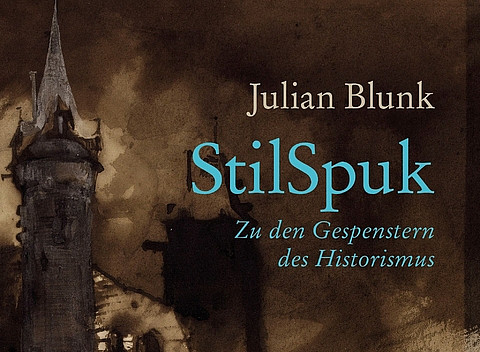
At first glance, ‘style’ – as a classificatory category of the formal characteristics of works of art – and ‘haunting’ – as the nocturnal wanderings of the undead – appear to have little in common. In fact, however, under the banner of historicism, these two conceptual frameworks are united by a structural logic and a mutual attraction: The debates concerning the historical development of style, the nature of the zeitgeist, and the appropriate style for the present day, alongside the debates concerning fictional or real ghosts in literary fantasy or spiritualism, have repeatedly converged at a common discursive centre – the question of a cultural legacy. Drawing on historiography, aesthetic theory and artistic practice, and between fictional ghost literature and spiritualist communication practices, Julian Blunk discusses the close interconnection between discourses on style and ghosts in terms of their terminological and motivic repertoire, their cycles, their breaks and their underlying patterns. In doing so, he opens up new perspectives on the culture of the ‘long 19th century’, which conjured up the ghosts of the past in order to define the spirit of the present.
Julian Blunk, born in 1972, is a professor of art history (18th to 20th centuries) at the University of Graz. After studying art history and film and television studies in Bochum, he was a research fellow at the International Research Training Group 625 ‘Institutional Orders, Writing and Symbols’ at the Technical University of Dresden and the ÉPHÉ in Paris. Following his PhD, he was a research assistant at the Institute for Art History and Aesthetics at the Berlin University of the Arts from 2008 to 2016 and a postdoctoral researcher in the research group ‘BildEvidenz’ at the Free University of Berlin. Publications include: *Style as (Intellectual) Property* (co-ed., 2018); *Film Style: Perspectives on a Concept* (co-ed., 2016); *Manipulating the Dead. The French Royal Tombs in the Early Modern Period (2011).