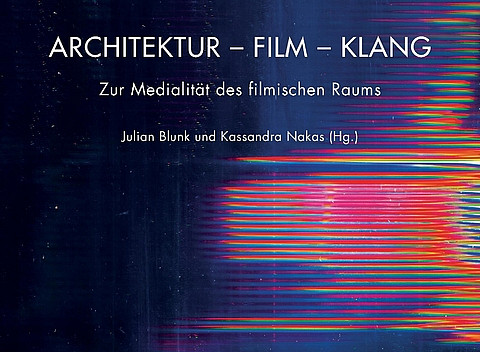
Films shape our perception of the world: they are a collective space of experience, a cultural memory, and an ever-evolving art form. They create imaginary environments, explore social relationships, and speak to our emotions. The places, spaces, and architectures of these projections play just as much a role in such processes of subjectivation as the noises, tones, and sounds that unfold within them. The contributions in this publication explore this synaesthetic dimension—comprising space, film, and sound—from an interdisciplinary perspective. Through concrete case studies and methodological approaches, the contributors examine—from the perspectives of art, film, media, and music studies—how spaces are constructed, interpreted, and made emotionally tangible through the interplay of image and sound. Architecture is revealed not only as a physical building but as a sensually mediated experience; noises, tones, and music, in turn, are presented as immaterial yet space-forming modes of aesthetic perception.
With contributions by: Maria Behrendt, Julian Blunk, Ralf Michael Fischer, Lilian Haberer, Ulrike Hanstein, Lisa Hecht, Saskia Jaszoltowski, Gertrud Koch, Katja Müller-Helle, Kassandra Nakas and Matthias Weiß
After completing his studies in art history and film and television studies in Bochum, Julian Blunk conducted research and taught at the Technical University of Dresden, the EPHE in Paris, the Berlin University of the Arts, and the Free University of Berlin. Since 2022, he has been a professor of 18th- to 20th-century art history at the Department of Art and Musicology at the University of Graz.
Kassandra Nakas earned her Ph.D. in art history from Freie Universität Berlin and completed her habilitation at Leuphana University Lüneburg, where she also teaches. Previously, she was a visiting professor at the Berlin University of the Arts, the State Academy of Fine Arts in Karlsruhe, and Ludwig Maximilian University in Munich.