


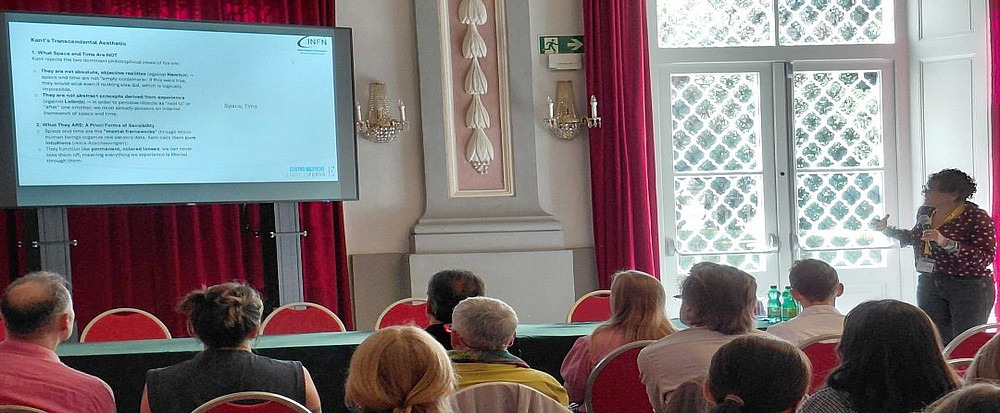
For three days, the University of Graz became the venue for an extraordinary dialogue between physics, musicology, art history, philosophy and theology as part of the ORF musikprotokoll 2026 “Supernova”. The symposium, inspired by an excursion to the SciArtDialogue Week at CERN, brought together international experts, artists and students to re-explore the boundaries between science and art. The focus was on questions such as how the invisible processes of the universe can be translated into artistic forms of expression, and how new narratives and materials emerge at the intersection of the two disciplines.
The opening on 6 October already sent a strong signal: Simon Riedl (City of Graz), Markus Fallenböck (Vice-Rector of the University of Graz), Klemens Fellner (Faculty of Natural Sciences) and Anouschka Foltz (Faculty of Humanities) welcomed the guests before the organisers, Susanna Niedermayr (ORF musikprotokoll) and Susanne Kogler (Department of Art History and Musicology, University of Graz) introduced the theme. The varied programme ranged from lectures on the colours of the early universe and artistic perspectives on quantum physics to transdisciplinary projects such as art@CMS/ORIGIN.
A workshop, the panel discussion with representatives from ‘steirischer herbst’, and the accompanying talk as part of the opening of the ‘Supernova’ exhibition at the Volkskundemuseum – organised by artists and students from the KUG – turned the symposium into a vibrant laboratory for new ideas, thematically embedded within the artistic programme of ORF musikprotokoll. In particular, the ‘Thinking Outside the Box’ workshop with Pablo Garcia Tello (CERN IdeaSquare) encouraged participants to break away from familiar patterns of thought and shape the future together.
The ‘Space, Time and Material’ symposium impressively demonstrated just how inspiring and productive the encounter between science and art can be – and just how much potential lies in the collaboration between these two worlds.